Enough of the snidery of the last two posts: let’s get back to what this blog is famous for quite well known for around the world among a very small number of people: shining a torch on obscure bits of brewing history.
Regular readers may remember a post from last year about the “double drop” system of fermentation, during which, in passing, I mentioned another old method of “cleansing” fermenting beer of its excess yeast, the “ponto” system. This, according to the Encyclopaedia Britannica of 1911, “consists in discharging the beer into a series of vat-like vessels, fitted with a peculiarly shaped overflow lip. The yeast works its way out of the vessel over the lip, and then flows into a gutter and is collected.”
I remarked at the time that “ponto” was a curious word, not in the Oxford English Dictionary, and guessed that it might be derived from “pontoon”, because the “peculiarly shaped overflow lip” (you can see some here, pictured in the Porter Tun Room at Whitbread’s brewery in London) looked like the end of a pontoon or punt.
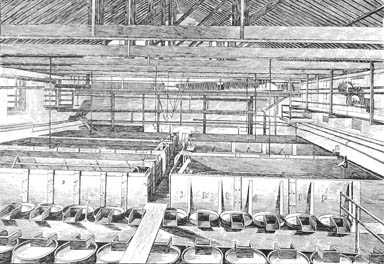
Aha! While digging around in Google Books a short while ago, I found an illustration of identical vessels being used in a brewery in Albany, New York in the middle of the 19th century, vessels that are referred to as “pontoons”. What’s more, it is clear that the brewery owner, John Taylor, had brought the “pontoon” concept back with him from London. Here’s a picture of Taylor’s pontoon room

– you can see the “pontoons” look identical to Whitbread’s pontos – and here’s a couple of quotes from a curious book called Ale in Prose and Verse by Barry Gray and John Savage, published in 1866, from which the picture above comes, and which is mostly taken up with praising Taylor’s ales. The first is about Taylor’s trip back to England (he was born in either Durham or Chester, and came to the young United States with his parents around the start of the 19th century), when he had already been running a brewery in Albany for a couple of decades. While in the old country he decided to look at what was happening in the British brewing industry:
“A man gifted, as he was, with large perceptive faculties could not pass through the great breweries of Great Britain without adding to his store of information and learning many things which could be advantageously adapted to his business. Many of these breweries he examined with close attention, and whatever was novel, either in the machinery or manner of operation, was carefully studied and noted down. In some instances he made elaborate drawings of such portions of the works as he deemed it desirable to imitate, and often under circumstances unfavorable to such labor. After duly considering and comparing the various advantages accruing to the breweries from their mechanical or other improvement, he decided to select the Lion Brewery of London, with such additions and improvements as his own observation and judgment would enable him to graft upon it, as the model from which to erect, on his return to Albany, a brewery which would favorably compare with those of the old world, and far excel any which up to that period had been erected in this country.”
The Lion brewery he visited must have been Goding’s brewery on the South Bank, erected in 1836/7, which was one of the biggest of London’s ale breweries (that is, non-porter ones). Gray and Savage say Taylor made his trip across the Atlantic in 1860, but as he rebuilt his brewery in Albany in 1851 they must mean 1850, at which time the Lion brewery would have been barely a dozen years old, and probably pretty cutting-edge in terms of its equipment. (It ran until 1924, when it was brought by Hoare and Co, whose brewery stood just to the east of St Katharine’s Dock, on the outskirts of Wapping. The Lion brewery buildings were eventually demolished in 1949 to make way for the Royal Festival Hall, though the Coade Stone lion that was once mounted on top of the brewery still, as I’m sure I must have said here before, stands guard by Waterloo Westminster Bridge. Its fellow, which was over the brewery gate in Belvedere Road, can now be found, painted gold, at Twickenham Rugby ground.)
We can be pretty certain, I think, that Taylor saw pontos being used at the Lion brewery and brought the idea home to Albany, though whether the name changed mid-Atlantic to pontoon, or whether pontoon was what the Lion brewery called them seems impossible to say. Here’s Gray and Savage’s description of Taylor’s pontoon room:
“Perhaps the most remarkable feature of Taylor’s Brewery is to be found in the pontoon room. Standing on an elevated platform at one end of the vast apartment, the eye of the spectator passes over three hundred and sixty five white cedar vessels or pontoons, capable of holding twenty six hundred barrels, placed in regular order and divided into five sets. Between them wooden troughs are arranged which carry off the yeast as it purges from the new-made ale contained in them undergoing the process of cleansing. From each pontoon the creamy yeast, crowned with foam reminding one of white-capped billows, slowly pours itself into the receiving troughs. Heretofore this refining process was effected solely by hand, a slovenly and dirty process which, until this pontoon apparatus was introduced by Mr Taylor in his present brewery, was the only one employed in this country. Even now the expense necessary for making the change deters many breweries from adopting the new and more perfect and cleaner process.”
“Pontoon” is certainly not a mistake of Gray and Savage’s for ponto, since a later book, A History of American Manufactures from 1608 to 1860, published in 1868, also calls the vessels pontoons. By now, five years after John Taylor’s death, and with the brewery being run by his sons, it was the largest in the United States, producing 200,000 (presumably US) barrels a year. This was only about half the output of the biggest London brewers, but still a substantial operation. The History of American Manufactures said of John Taylor’s Sons brewery:
“Previous to its erection in 1850 the senior of this firm visited Europe and made drawings of the most important improvements which he saw in the London Breweries. The pontoon apparatus for cleansing and refining the ale, consisting of three hundred and sixty five large cedar vessels, with floats so arranged as to open and shut the valves, the liquor being always at the same height, independent of the flow of yeast in the receiving troughs, is as yet a novelty in American breweries.
 Taylor’s operation was an ale brewery, like Goding’s in London, and he does not appear to have made either porter or the new-fangled lager. In 1850 he was advertising in a New York directory: “John Taylor and Sons Albany Imperial Pale and Amber Ale constantly on hand and for sale in hogsheads, barrels and half barrels, either for city use or shipping.” Here’s another Taylor ad, from 1857. Don’t tell Ron Pattinson about that “Imperial Pale” and “Imperial XX” – in fact “Imperial” seems to have been a Taylor trademark, rather than any attempt to suggest his beer was extra strong, since the word was used with several of his beers: when Gray and Savage eulogised his brews in verse, they declared:
“Among the ales most famed in story
From Adam’s down – or old or new –
There’s none possessing half the glory,
Or half the life of Taylor’s brew.
Their “amber” brand is light and cheery,
Their “XX” is strong though pale,
But give to me, when dull and weary,
Their cream, imperial “Astor” ale.”
and a picture of one of their depots shows a board advertising “Imperial Pale and Cream Ales”. What’s the bet, incidentally, that Taylor’s XX strong pale was a London-style pale mild ale?
The Taylors are sometimes said to have sold the brewery in the 1870s, though the rather sad cutting below from the New York Times in 1880 suggests otherwise, and the 1891 census of Albany recorded Edward L. Taylor as vice-president of the brewing company and Nicholas B. Taylor as its president. The brewery seems to have closed its doors in 1905. Did any other American brewing concern take up the idea of pontoons, or pontos? I doubt it, but I’d love to be proved wrong.




That lion is doing the business on the south side of Westminster Bridge, Martyn – outside what used to be County Hall.
My bad – thanks, Sid, now corrected …
“Taylor’s operation was an ale brewery… he does not appear to have made either porter or the new-fangled lager.”
It appears from advertisments and directory listings from the 19th century, at least here in Philadelphia, PA, the lager beer brewers were the companies making porters and “brown” stouts. The exception was Christian Schmidt & Sons, which in 1909 advertised making lager, ale and “brown” stout.
I suppose the devices were described as pontoons to Taylor in England, and he took the word with him to America. Meanwhile, in other breweries and possibly other parts of the same brewery, the brewers had taken to using ponto as an abbreviation. Speculation, of course, but it doesn’t make any sense to me the other way around.
The term might have been an affectionate diminutive, as e.g., when an Englishman calls his friend, surnamed Robinson, “Robbo”. This seems a purely U.K. habit.
Gary
I realize that this post on pontos is pretty old at this point (not sure what the shelf life is for these things), but I recalled it as I was reading an 1851 description of the Reed & Brothers brewery in Troy, New York. Part of that description is as follows
“The cellars are capacious and cool, and when the brewery is in full blast and manufacturing at a rate of 300 bbls. per day, are of sufficient capacity to ferment 1800 bbls. at a time. As we said just now, the beer is run off from the tuns into puncheons holding two or three barrels, where it is left to ferment. We noticed, as a curious circumstance, familiar enough, however, to brewers, that a very slight pressure of the thumb against the head of one of these large puncheons, would be instantly indicated by a corresponding lifting of the foamy yeast escaping the bung hole.” (Troy Daily Times, October 21, 1851)
Now, it strikes me that puncheon is fairly close to pontoon, and as it is a term that refers to large capacity wooden vessel much like those pictured at Whitbread and the Taylor breweries, it might fit the bill in regards to process (and the term). I realise that there is no description of the troughs in this, but they needed to run off the yeast somehow.
Other sources describing American breweries also discuss the use puncheons. According to Edwin Troxwell Freedly in Philadelphia and its Manufactures (1858), porter breweries in that city employed “all the best modern improvements made in England.” When discussing fermentation he explained that:
“To prevent the creation of too high a temperature, which would cause acidity of the worts, it is racked off from the fermenting vats into puncheons of one hundred and twenty to one hundred and fifty gallons, where it purges itself of its yeast.” (p. 194)
Later writers reviewing American fermentation methods discussed the difference of “beer produced by the dropping system with one which has been cleansed in a puncheon.” (Arthur A. Ling, “Changes Which Occur in the Fermenting Vessel, Storage Vat and Cask,” in The Brewer’s Journal and Barley, Malt and Hop Trades’ Reporter, Vol. 40 (1916), p. 389).
While hardly conclusive, it is appears that the “pontoon system,” or something much like it with a similar name, was used in Philadelphia porter breweries, as well as in a couple of ale brewerIes in cities on the Hudson in New York state.
Of course, I could have this all bullocksed up.
Gerry
A quick follow up. After a little more digging, I found other references to the use of puncheons in fermentation/cleansing. One is in a story about the planned construction of the new Burt brewery in Albany which mentions the then ongoing work on the new Taylor brewery. In discussing the process of brewing the story notes:
“…after being cooled, it runs down into the tuns, which are huge reservoirs, where fermentation takes place and yeast is created; the puncheons, which are large casks, next receive it, and in these it undergoes the last process of fermentation and cleansing.” (Troy Daily Whig, Sept., 25, 1851)
So, here in a story that references the new Taylor brewery we see an explanation of a system that seems to have been the same and that was in use (or planned to be in use) in other area breweries. A later story (1869) describing “worthy and valuable improvements” made in the brewing industry also notes the used of puncheons: “Next on the list of valuable introductions” notes the author, ” are the cleansing vats, which have superceded the use of puncheons, which contain only five barrels a piece and in which fermentation took place, the yeast and sediment finging its way out of the bung, and which, to say the least, was a very tedious protracted process.” (Troy Daily Whig, Nov. 6, 1869) The new vats replacing puncheons had a capacity of 100-200 barrels each. The description of the process came from the Eagle Brewery in Troy.
Nothing like being nine years late: I now suspect the “puncheons” were being used in what hs been referred to as the “farmhouse system”, where the barrels, or in this case puncheons, casks with a capacity of two barrels (62 gallons in US terms) sat over troughs or gutters which received the yeast and beer spilling from the cask via the bunghole.
[…] but what is to be done with outdated tech? Is there anyone lobbying for the return of the “ponto” system? Nope. “Inevitable” says The Mudge. One of the things small scale brewers can […]